Matthew 24:12 And because lawlessness will be increased, the love of many will grow cold. -Jesus
France… “Mostly peaceful protests” from immigrants of the religion of peace. The main stream press tells us these are student protests about requesting better education and resources.
Riots across France today.
Looting, fires, vandalism and attacks against policemen and firefighters reported from cities across the country. pic.twitter.com/ZpVnuXTvC3
And let us not forget when the opening ceremony of the Paris Olympics, July 2024, mocked Jesus and the Last Supper…
Why am I not surprised France is on fire after how the Macron-Rothschild establishment disrespected Christianity at the Olympics? If you don't respect your own culture, nobody else will. If you laugh at the sacred, you end up on fire. This is really very obvious. pic.twitter.com/N0f3f2UlKb
The Olympic spirit is alive and well from the city of lights and love, gay Paris. Hope you had your fun with rebellion, taunting, and scoffing. I guarantee Somebody is watching and will respond accordingly and at a time of His choosing. -PaulthePoke, July 2024…
Luke 21:25b …and on the earth distress of nations in perplexity because of the roaring of the sea and the waves… -Jesus
With the 3 hurricanes that are set to hit the U.S, some have pointed out something interesting about them. With the meaning of these 3 hurricane's names put together, it can make a sentence saying: Sheep, listen (or hear), Yahweh is salvation! Do you think this is just… pic.twitter.com/zHWavE9CBF
Isaiah 51:15 I am the LORD your God, who stirs up the sea so that its waves roar, the LORD of hosts is His name.
~
Quakes in various places… -Jesus
Panama in the crosshairs of another big earthquake…
October 9, 2026, at 12:56 local time (17:56 UTC), a 7.7 earthquake struck Panama’s Azuero Peninsula.
#PANAMÁ: Terremoto de magnitud preliminar 7.7 interrumpe -en vivo- un programa deportivo en la ciudad de #Santiago 🇵🇦, a 60 km de distancia del epicentro.📍
Casualties: 1 death; at least 27 injured (mostly minor to moderate)
Damage: Concentrated in Los Santos, Herrera, Veraguas, and Coclé provinces. Assessments of more than 9,000 homes found roughly 2,300 with total damage/loss, thousands more with moderate/partial damage, plus hundreds of schools, dozens of health facilities, churches, hotels, government buildings, bridges, and road sections affected. Some communities were isolated by collapsed roads or landslides. Power outages hit multiple provinces; Tocumen International Airport briefly suspended operations for inspections. Sinaproc.gob
The Panama Canal and major mining operations continued largely normally. A tsunami warning for parts of the eastern Pacific was issued and later canceled with no significant waves. -Summary by Grok
~
CPC is the leading conservative non-profit in Kentucky, standing for life, marriage, religious freedom, and fiscal responsibility.
Zechariah is one of the most breathtaking books in all of Scripture.
Its name means “YHWH remembers,” and that truth runs through the entire book.
God remembers His covenant. The LORD remembers Jerusalem. The Holy One of Israel remembers His people. The King remembers every promise He has spoken.
Zechariah begins with a returned remnant, a damaged city, and a Temple being rebuilt. But the prophecy quickly moves far beyond Zechariah’s own generation.
The horizon expands to Israel’s future, Messiah’s coming, Jerusalem’s central role, Israel’s repentance, the judgment of the nations, and the establishment of the Kingdom.
Zechariah is a prophetic mountain range.
GOD HAS NOT FORGOTTEN JERUSALEM
The LORD declares: “I am exceedingly jealous for Jerusalem and for Zion.” Zechariah 1:14
And again: “I have returned to Zion and will dwell in the midst of Jerusalem.” Zechariah 8:3
Then comes one of the most beautiful pictures of restoration: “Old men and old women shall again sit in the streets of Jerusalem… and the streets of the city shall be full of boys and girls playing.” Zechariah 8:4–5
Jeremiah gives the same assurance: “If this fixed order departs from before Me… then shall the offspring of Israel cease from being a nation before Me forever.” Jeremiah 31:35–36
And in that same chapter: “I will make a new covenant with the house of Israel and the house of Judah.” Jeremiah 31:31
Ezekiel adds: “I will take you from the nations and gather you from all the countries and bring you into your own land.” Ezekiel 36:24
Then comes spiritual renewal: “I will sprinkle clean water on you… and I will give you a new heart.” Ezekiel 36:25–26
Zechariah is not standing alone. He is part of a much larger prophetic chorus.
THE KING CAME HUMBLE
Zechariah foretold the arrival of Israel’s King: “Behold, your king is coming to you, righteous and having salvation is He, humble and mounted on a donkey.” Zechariah 9:9
Yeshua fulfilled that prophecy literally. But the next verse looks beyond His humble arrival: “His rule shall be from sea to sea, and from the River to the ends of the earth.” Zechariah 9:10
The same Messiah who came in humility will rule in glory. First the suffering. Then the crown.
THE SHEPHERD WOULD BE STRUCK
Zechariah also foretold Messiah’s rejection: “Strike the shepherd, and the sheep will be scattered.” Zechariah 13:7
Yeshua Himself applied this passage to what was about to happen to Him. But Zechariah never leaves the story at rejection. The Shepherd who was struck will return as King.
ISRAEL WILL LOOK UPON THE ONE THEY PIERCED
Zechariah 12 is one of the most remarkable passages in the Tanakh. The LORD says: “I will pour out on the house of David and the inhabitants of Jerusalem a spirit of grace and pleas for mercy.” Zechariah 12:10
Then comes the stunning line: “They will look on Me, on Him whom they have pierced, and they shall mourn for Him.”
Recognition. Repentance. Grace. Restoration.
And the next chapter follows with cleansing: “On that day there shall be a fountain opened for the house of David and the inhabitants of Jerusalem, to cleanse them from sin and uncleanness.” Zechariah 13:1
Yeshua later spoke of a future day when Jerusalem would welcome Him: “You will not see Me again, until you say, ‘Blessed is He who comes in the name of the Lord.’” Matthew 23:39
Paul says the same storyline continues in Romans 11: “A partial hardening has come upon Israel, until the fullness of the Gentiles has come in.” Romans 11:25
Then: “And in this way all Israel will be saved.” Romans 11:26
And why can we trust that promise? “For the gifts and the calling of God are irrevocable.” Romans 11:29
Israel’s story is not finished.
JERUSALEM WILL STAND AT THE CENTER OF WORLD EVENTS
Zechariah says: “I will make Jerusalem a heavy stone for all the peoples.” Zechariah 12:3
The nations gather against the city.
But Jerusalem is not only the center of conflict. It is also the center of the coming Kingdom.
Isaiah saw the same future: “It shall come to pass in the latter days that the mountain of the house of the LORD shall be established.” Isaiah 2:2
And: “For out of Zion shall go forth the law, and the word of the LORD from Jerusalem.” Isaiah 2:3
Jerusalem is not erased from the prophetic story. It becomes central to it.
THE GOD OF ISRAEL WILL INTERVENE
Zechariah describes a future moment when the nations gather against Jerusalem. Then: “The LORD will go out and fight against those nations as when He fights on a day of battle.” Zechariah 14:3
And then comes one of the most dramatic prophecies in Scripture: “On that day His feet shall stand on the Mount of Olives that lies before Jerusalem on the east.” Zechariah 14:4
The mountain splits. The geography is specific. Jerusalem. The Mount of Olives. A real city. A real mountain. A real intervention.
Revelation 19 describes Messiah’s triumphant return as heaven opens and the King comes in righteousness and judgment.
Then Revelation 20 follows with His thousand-year reign.
The sequence is powerful: The King returns. His enemies are judged. Israel is restored. The nations come under His rule. The Kingdom is established.
THE KING WILL REIGN OVER ALL THE EARTH
Zechariah reaches its climax here: “The LORD will be King over all the earth.” Zechariah 14:9
That is where history is heading. Not toward the failure of God’s promises. Not toward the abandonment of Israel. Not toward the disappearance of Jerusalem from the prophetic plan.
But toward the reign of the King.
Living waters will flow from Jerusalem. The nations will come to worship. The city will be holy.
And: “Everyone who survives of all the nations… shall go up year after year to worship the King.” Zechariah 14:16
That is the breathtaking message of Zechariah.
The God of Israel remembers. The Shepherd was struck. The King is coming. Jerusalem will see Him. Israel will be restored. The nations will worship.
And one day: “The LORD will be King over all the earth.” Zechariah 14:9
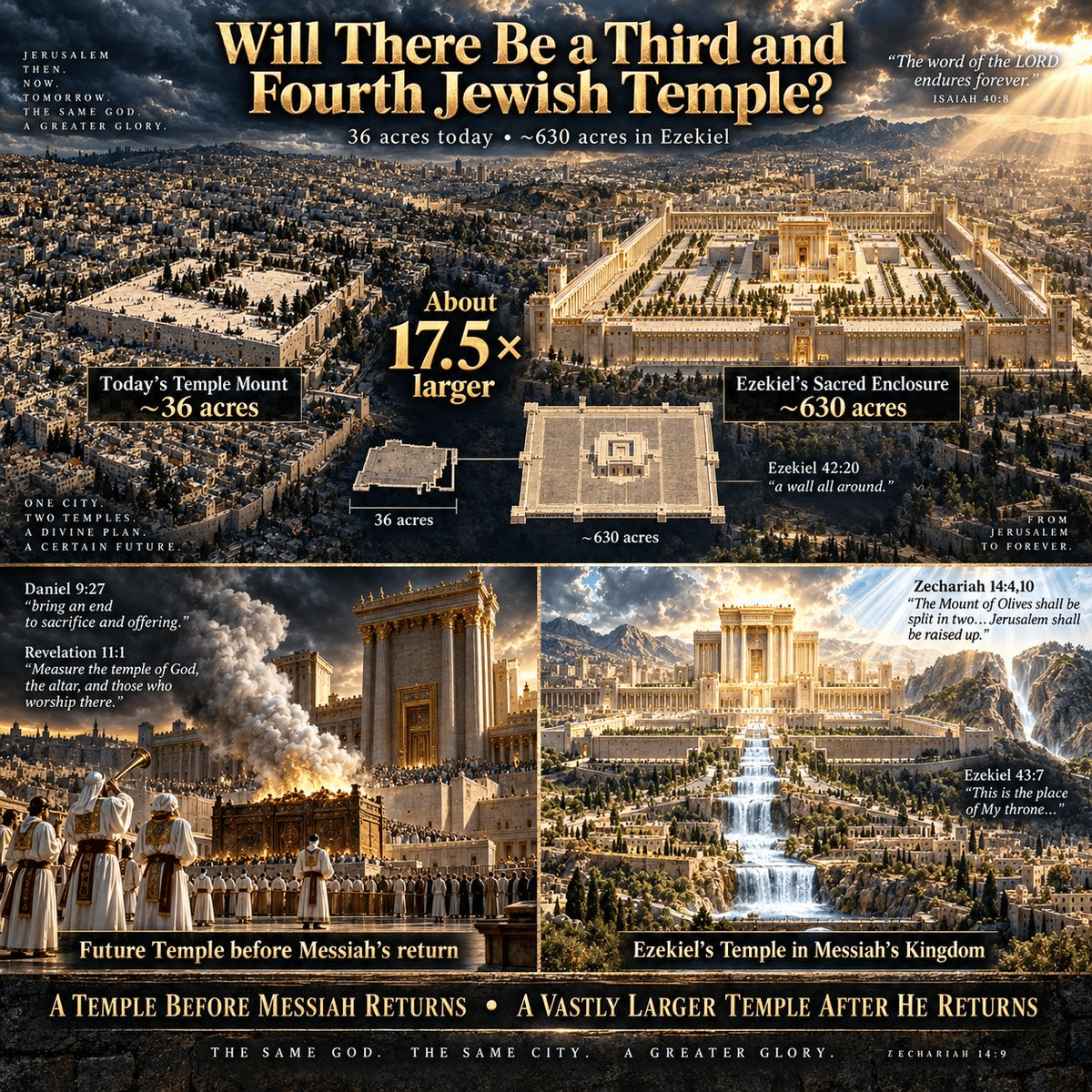
Here is a remarkable problem: Ezekiel’s future Temple complex does not fit on today’s Temple Mount.
The present Temple Mount covers approximately: 36 acres.
But on the traditional 500-reed reading of Ezekiel 42:15–20, Ezekiel’s sacred enclosure would cover roughly: 630 acres.
That is about 17½ times larger. 36 acres today.
630 acres in Ezekiel.
That is not a minor architectural difference. It may be an important clue that Scripture describes two different future Temple settings.
A TEMPLE BEFORE MESSIAH RETURNS
Daniel writes: “In the middle of the week he shall bring an end to sacrifice and offering.” Daniel 9:27
For sacrifice to be stopped, sacrifice must first be occurring.
Jesus then points directly back to Daniel: “When you see the ‘abomination of desolation,’ spoken of by Daniel the prophet, standing in the holy place…” Matthew 24:15
Paul adds that the man of lawlessness: “sits as God in the temple of God.” 2 Thessalonians 2:4
And John is told: “Rise and measure the temple of God, the altar, and those who worship there.” Revelation 11:1
The surrounding context gives us Jerusalem and 42 months. Notice the progression:
This is what Christians commonly call the Third Temple. The Bible never uses that number. It is simply shorthand for a Jewish sanctuary existing after the Second Temple and before Messiah’s kingdom.
AND THIS IS NO LONGER PURELY THEORETICAL
No Third Temple is currently under construction.
But preparations associated with future Temple worship are real.
The Temple Institute in Jerusalem continues preparing sacred vessels, priestly garments, and other elements connected with renewed Temple service. It has also clarified recent speculation about the red heifers: an earlier burning was only a practice exercise, while several heifers remain under evaluation. Jewish worship on the Temple Mount has also become more visible in 2026, including expanded use of prayer materials and public prayer in circumstances that would have been highly restricted in previous years.
None of this proves Daniel’s seventieth week has begun.
Prophecy calls for watchfulness, not date-setting.
But after nearly 2,000 years without a Jewish Temple, renewed discussion of Temple worship is no longer purely hypothetical.
THEN COMES JACOB’S TROUBLE
Jeremiah describes an unprecedented future crisis: “It is the time of Jacob’s trouble, but he shall be saved out of it.” Jeremiah 30:7
Daniel echoes it: “There shall be a time of trouble, such as never was since there was a nation.” Daniel 12:1
Jesus uses almost identical language: “Then there will be great tribulation, such as has not been since the beginning of the world.” Matthew 24:21
Jeremiah.
Daniel.
Jesus.
An unparalleled crisis centered on Israel and Jerusalem, followed by deliverance.
ZECHARIAH SHOWS WHY THIS IS STILL FUTURE
Zechariah says: “Two-thirds in it shall be cut off and die, but one-third shall be left in it.” Zechariah 13:8
Then the surviving third is refined: “They will call on My name, and I will answer them. I will say, ‘This is My people’; and each one will say, ‘YHVY is my God.’” Zechariah 13:9
And the prophecy continues directly into chapter 14:
Jerusalem attacked. The nations gathered. YHVY goes forth to fight. His feet stand upon the Mount of Olives. Zechariah 14:1–4
That complete sequence has never occurred.
Neither Antiochus IV nor AD 70 fulfilled it.
The Holocaust was an unspeakable catastrophe, but it did not culminate in the full Zechariah 13–14 sequence of national refining, YHVY’s intervention, and His feet standing upon the Mount of Olives.
That is why the futurist reading understands Jacob’s Trouble as still future.
DOES THE TANAKH REALLY REQUIRE TWO FUTURE TEMPLES?
This is one of the strongest Jewish objections. A Jewish reader can reasonably argue:
Daniel’s desecration prophecies were fulfilled in ancient history, while Ezekiel 40–48 describes the future Messianic Temple. Why introduce another Temple between them?
So leave the New Testament aside for a moment. Daniel 12 itself gives us:
Daniel 12:1–2, 11 Antiochus IV did not complete that sequence. Neither did Titus in AD 70.
Zechariah likewise points to a future crisis culminating in YHVY’s direct intervention at Jerusalem.
The Tanakh itself therefore points toward a future climactic period involving Israel, Jerusalem, sacrifice, desecration, national refining, divine intervention, and deliverance.
The New Testament does not invent that expectation.
It adds further detail.
COULDN’T EZEKIEL’S TEMPLE SIMPLY BE THE NEXT TEMPLE?
Possibly, if the settings were the same. But they are not.
The sanctuary associated with Daniel exists amid: Sacrifice. Desecration. Unprecedented trouble. Jerusalem under assault.
Ezekiel’s Temple exists after restoration, in a reordered land, with tribal allotments, a supernatural river flowing from the sanctuary, and YHVY declaring:
“This is the place of My throne… where I will dwell in the midst of the children of Israel forever.” Ezekiel 43:7
Welcome to the last edition of the part 12 of the series, Debunking Replacement Theology.
One last time… the nation of Israel and the church or the bride of Jesus Christ, are two separate entities. God has not changed His mind. The church has not replaced Israel. God has a unique plan for both.
And by the way critic, if God can break His covenant and replace His people Israel with the church as you have suggested, then He can change His mind about your personal salvation too… But fear not!
Hebrews 13:8 Jesus Christ is the same yesterday and today and forever.
And another thought for the critic… if the church replaces Israel, then the church will go through God’s wrath and judgment on earth.
Christ has already paid the price and taken His Bride’s place. Do you, self proclaimed believer in Christ, want to bring judgment upon yourself? Did Jesus die in vain on the cross?
The church replacing Israel makes no logical sense for many reasons as demonstrated during this series.
~
Location, Location, Location
Revelation chapter 6 introduces judgment on Earth with the four horsemen of the Apocalypse. It is not until chapter 7 that Israel is mentioned. Israel is located on Earth where and while judgment is taking place. The twelve tribes of Israel are reintroduced in sets of 12,000 for a total of 144,000.
At the same time, it would appear the church and elders remain in Heaven.
Saints, who likely converted to Jesus after the resurrection and rapture, on Earth are present and dying. Note the saints who die on Earth join the God the Father, God the Son, the elders and angels in Heaven.
Revelation 7:9-11 After these things I looked, and behold, a great multitude which no one could count, from every nation and all tribes and peoples and tongues, standing before the throne and before the Lamb, clothed in white robes, and palm branches were in their hands; and they cry out with a loud voice, saying, “Salvation to our God who sits on the throne, and to the Lamb.” And all the angels were standing around the throne and around the elders and the four living creatures; and they fell on their faces before the throne and worshiped God…
Judgment continues on Earth with the introduction of the two witnesses in Revelation 11 in Jerusalem. Satan is thrown out of Heaven and down to Earth by the angel Michael in chapter 12. The antichrist and the false prophet enter the scene on Earth in Revelation 13.
In Revelation 14, Jesus the Lamb has moved from Heaven to Earth. His location is Mount Zion, a specific location in Jerusalem. 144,000 Israelis have joined Him for choir practice.
Meanwhile back in Heaven, the elders or the church are singing before the throne of God the Father. Israel is on Earth. The church is in Heaven.
The two entities, Israel and the church, are different in name and physical location in the context of the chapters in Revelation7-14.
The text could not be any clearer. Replacement Theology or Supersessionism is a myth.
Judgment continues on Earth through Revelation 18 then the setting changes to Heaven in chapter 19. The Lamb and His bride the church are married in Heaven. Then Christ and His army descend to Earth. The beast and his troops decide to engage the King of Kings on Earth. The result of the antichrist and the false prophet is the lake of fire on Earth. Satan has a 1,000 year time out chained up in the abyss.
Israel has remained a country on Earth during this period of time. Israel is on Earth and ready to usher in the kingdom.
The church is destined for resurrection and rapture before Israel has a seven year period of judgment. The church returns to earth to rule and reign with the King of Kings over the world through nation Israel for 1,000 years and into eternity.
~
This series is an excerpt from the book, Rapture the Bride Redeemed.
Leviticus 23:33-36 Again the LORD spoke to Moses, saying, “Speak to the sons of Israel, saying, ‘On the fifteenth of this seventh month is the Feast of Booths for seven days to the LORD. On the first day is a holy convocation; you shall do no laborious work of any kind. For seven days you shall present an offering by fire to the LORD. On the eighth day you shall have a holy convocation and present an offering by fire to the LORD; it is an assembly. You shall do no laborious work.’”
On our western Gregorian calendar in 2026, the Feast of Tabernacles will be observed from about Friday, September 25th to Friday, October 2th (Great Day). Or pending the new moon confirmed at the beginning of the Hebrew month of Tishri.
This year, the Essenes mark the beginning of Tabernacles on Wednesday, September 30th and runs through Tuesday, October 6th. The last and Great Day occurs on Wednesday, October 7th.
The third and last fall holiday on God’s calendar is Tabernacles. It is also called Sukkot, the Feast of Booths, the Festival of Tents, or the Feast of the Harvest because it was after the harvest in the fall. Simply put, it was also called “the Feast” or “the Festival”. This festival is a week-long festival from Tishri 15 to 21 on a Hebrew calendar.
Jews sing Isaiah 12:3 Therefore you will joyously draw water from the springs of salvation, during the Feast of Tabernacles or Sukkot.
The Jewish holiday is a reminder to the Jewish people they lived in tents after the Exodus from Egypt.
In addition, the Feast of Tabernacles requires sacrifices of sin offerings and burnt offerings. At the time of preparation for the morning sacrifice, a priest descends to the Pool of Siloam amidst great music, celebration, and singing of Isaiah 12:3, and fills a golden pitcher with water. After dipping his pitcher in Siloam’s water, the priest returns to the Temple and pours the water into one of the silver basins by the altar (Wayne Stiles, Insight for Living).
Jesus connects the dots for us in the Book of John. He is promising those who believe in Him the Holy Spirit. Jesus is making this proclamation on the last day of the Jewish holiday of Sukkot.
John 7:37-39 Now on the last day, the great day of the feast, Jesus stood and cried out, saying, “If anyone is thirsty, let him come to Me and drink. He who believes in Me, as the Scripture said, ‘From his innermost being will flow rivers of living water.’” But this He spoke of the Spirit, whom those who believed in Him were to receive; for the Spirit was not yet given, because Jesus was not yet glorified.
This chapter of Isaiah is a universal promise to the entire world. The Holy One, Jesus is our salvation. Isaiah 12 refers to the promise of the Holy Spirit and the reign of Jesus. And He is going to live and dwell with us.
John 4:14 “…but whoever drinks of the water that I will give him shall never thirst; but the water that I will give him will become in him a well of water springing up to eternal life.”-Jesus
Prophecy was never given merely to satisfy our curiosity about what happens next.
It was given to make us ready.
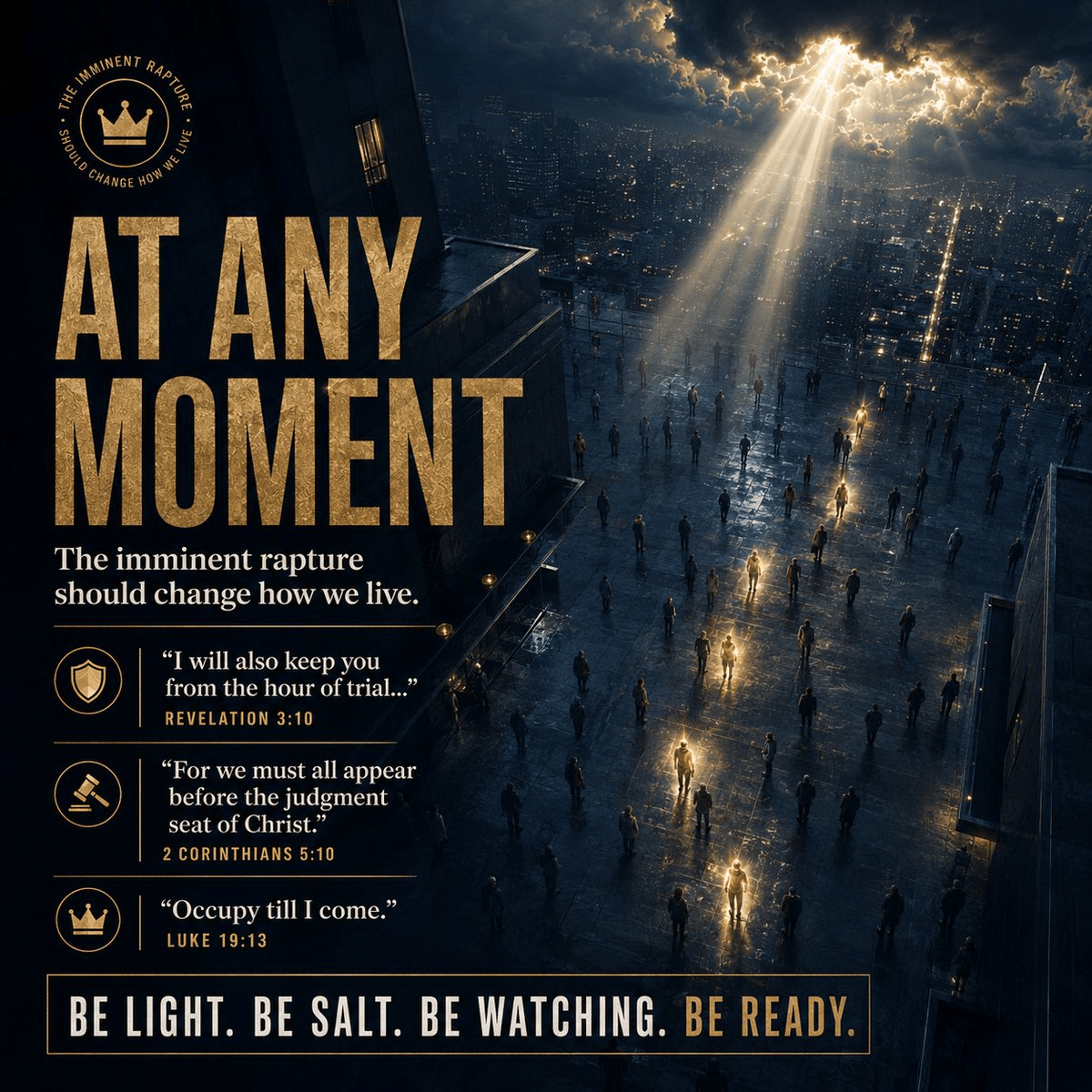
Jesus promised: “I will also keep you from the hour of trial that is going to come on the whole world…” Revelation 3:10
And Paul described the glorious gathering:
“We who are still alive…will be caught up together with them in the clouds to meet the Lord in the air.” 1 Thessalonians 4:17
If the Rapture is truly imminent, the Church should live with expectancy. But expectancy without accountability is incomplete.
Because after the gathering comes the Bema Seat.
“For we must all appear before the judgment seat of Christ…” 2 Corinthians 5:10
This is not judgment for salvation. Christ already bore our condemnation.
But grace does not erase accountability. Our works will be examined.
Our motives will be exposed.
Our stewardship will matter.
Scripture does not give us a transcript of the questions Jesus will ask, but it tells us clearly what will matter.
~
💡 HOW WERE YOU LIGHT IN THE DARKNESS?
“You are the light of the world.” Matthew 5:14
Did your life point people toward Christ? Did you shine when darkness increased? Or did you hide the lamp because shining became uncomfortable?
~
🧂 HOW WERE YOU SALT IN A DECAYING CULTURE?
“You are the salt of the earth.” Matthew 5:13
When truth became unpopular, did you preserve it, speak it, and live it? Or did you slowly become indistinguishable from the world?
~
📣 WHAT DID YOU DO WITH THE GOSPEL?
“Go into all the world and preach the gospel…” Mark 16:15
Who heard about Jesus because you were here? Who did you pray for? Who did you tell? Who might be in eternity because you refused to remain silent?
~
📖 WHAT DID YOU DO WITH THE TRUTH I GAVE YOU?
“Correctly handles the word of truth.” 2 Timothy 2:15
Did you contend for truth when compromise was easier? Did you handle Scripture faithfully? Or reshape it to fit the culture?
~
⏳ WHAT DID YOU DO WITH THE TIME I GAVE YOU?
“Making the most of every opportunity…” Ephesians 5:16
Your days were numbered. Your conversations were numbered. Your opportunities were numbered. Did you redeem them?
~
❤️ WHY DID YOU SERVE ME?
The Lord: “will bring to light what is hidden in darkness and will expose the motives of the heart.” 1 Corinthians 4:5
Did you serve Christ for His glory? Or for recognition, applause, influence, and reputation? Was it really about Him?
~
🔥 WHAT DID YOU BUILD THAT WILL SURVIVE?
Paul says every believer’s work will be tested. Gold. Silver. Precious stones. Wood. Hay. Straw.
“The fire will test the quality of each person’s work.” 1 Corinthians 3:13
Some things that look enormous on earth may disappear at the Bema. Some quiet acts of obedience nobody noticed may shine forever.
~
🛡️ WHEN FOLLOWING ME COST YOU SOMETHING, WERE YOU FAITHFUL?
“Blessed is the one who perseveres under trial…” James 1:12
Did you stand when standing became costly? Did you love Christ more than comfort?
~
🌿 WHAT DID YOU DO WITH ISRAEL?
Paul says salvation came to the Gentiles: “to make Israel envious.” Romans 11:11
So ask it plainly: Did my life provoke the Jewish people to jealousy for their own Messiah? Did I show them love? Did I pray for their salvation? Did I honor the people through whom came the covenants, the Scriptures, the patriarchs, and Messiah according to the flesh?
Or did I boast against the branches?
“Do not consider yourself to be superior to those other branches.” Romans 11:18
Gentile believers were called to gratitude, humility, mercy, prayer, and Gospel witness.
Did Israel see something in us that made them long for their Messiah?
~
👀 DID KNOWING PROPHECY ACTUALLY CHANGE YOU?
Did prophecy make us more holy? More urgent? More compassionate? More evangelistic? More focused on eternity? Or merely more informed?
“All who have this hope in him purify themselves…” 1 John 3:3
If prophetic knowledge never changes how we live, something is wrong.
~
👑 DID YOU OCCUPY UNTIL I CAME?
Jesus said: “Put this money to work… until I come back.” Luke 19:13
Then the nobleman returned and called his servants to account for what they had done with what he entrusted to them. That is the force of the Parable of the Minas.
The issue was not merely: “Did you know I was coming back?”
It was: “What did you do while I was gone?”
And for us: “What did you do because you believed I was coming?”
Not speculate until I come. Not retreat until I come. Occupy. Serve. Witness. Pray. Stand. Love. Work. Watch.
Because the Jesus who promised: “I will come back and take you to be with me…” John 14:3
also said: “Look, I am coming soon! My reward is with me…” Revelation 22:12
One day the trumpet will sound. The dead in Christ will rise. We who remain will be caught up together with them in the clouds. And so we will be with the Lord forever. 1 Thessalonians 4:16–17
Then every earthly opportunity will be over. No more darkness in which to shine. No more culture in which to be salt. No more person to evangelize. No more Jewish friend to love and provoke to jealousy for Messiah. No more assignment to finish.
And the question will no longer be: “When was the Rapture going to happen?”
It will be: “What did you do while you were waiting for Me?”
“Each of us will give an account of ourselves to God.” Romans 14:12
And even the crowns we receive will ultimately return to Him.
The elders cast their crowns before the throne: “You are worthy, our Lord and God…” Revelation 4:10–11
That is the destination. Not merely receiving a crown. Having something to lay at His feet.
Prophecy should not produce spectators. It should produce servants.
The imminent Rapture is not permission to abandon the world. It is a reason to spend ourselves for Christ while there is still time.
God’s Fall Appointments are the Feast of Trumpets, the Day of Atonement, and the Feast of Tabernacles. It’s that time of the year and the Feasts are approaching later this week.
~
Numbers 29:1 ‘Now in the seventh month, on the first day of the month, you shall also have a holy convocation; you shall do no laborious work. It will be to you a day for blowing trumpets.
See also Leviticus 23:23-25.
The beginning of the Jewish civil new year is upon us within the next week. This is the Hebrew month of Tishri. It will be the Hebrew year 5787 on a traditional, secular calendar. The date for Yom Teruah is calculated to be near sunset Friday, September 11th. Some will confirm the new year with the sighting of the new moon. The new year begins when the new moon is confirmed by two witnesses. The traditional Hebrew calendar is a lunar calendar.
As the Essenes mark time, the month of Tishri begins on Wednesday, September 16th. The Essenes celebrate their New Year in the spring with the beginning of Nisan or Abib per Exodus 12:2. This calendar is a solar calendar.
The first fall holiday has many names. It is called the Feast of Trumpets by Christians. It is recognized as the Jewish New Year, Rosh Hashanah. Some refer to it as the “Hidden Day” or the “Wedding of the Messiah”. In Judaism, it is called Yom Teruah which means the “Day of Blowing”.
The second fall holiday is the Day of Atonement. See Leviticus 16. Yom Kippur or the Day of Atonement is celebrated on Tishri 10th. It is the last day of the 40 day period of Teshuvah or repent in the Hebrew. This holiday is viewed at the holiest day of Judaism. The day is a Sabbath day of rest. Yom Kippur is the only day a fast is required. The day begins at sun down. This is the busiest day of the year for the high priest with multiple animal sacrifices.
The beginning for the Day of Atonement in 2026 is calculated at sundown Sunday, September 20th and ends the next day, Monday evening, September 21th. This date could be determined by the confirmation of the new moon 10 days earlier. The Essenes mark the date as Friday, September 25th through the next day.
Leviticus 23:33-36 Again the LORD spoke to Moses, saying, “Speak to the sons of Israel, saying, ‘On the fifteenth of this seventh month is the Feast of Booths for seven days to the LORD. On the first day is a holy convocation; you shall do no laborious work of any kind. For seven days you shall present an offering by fire to the LORD. On the eighth day you shall have a holy convocation and present an offering by fire to the LORD; it is an assembly. You shall do no laborious work.’”
The third and last fall holiday on God’s calendar is Tabernacles. It is also called Sukkot, the Feast of Booths, the Festival of Tents, or the Feast of the Harvest because it was after the harvest in the fall. Simply put, it was also called “the Feast” or “the Festival”. This festival is a week-long festival from Tishri 15 to 21 on a Hebrew calendar.
On our western Gregorian calendar in 2026, the Feast of Tabernacles will be observed from about Friday, September 25th to Friday, October 2th. Or, pending the new moon confirmed at the beginning of the Hebrew month of Tishri.
This year, the Essenes mark the beginning of Tabernacles on Wednesday, September 30th and runs through Tuesday, October 6th. The last and Great Day occurs on Wednesday, October 7th.
There are seven God appointed holidays communicated through the Mosaic Law. The first four in the Spring were fulfilled to the day by Jesus Himself with His death, burial, resurrection, and the giving of the Holy Spirit. If the first four Spring holidays were fulfilled by Jesus on the God appointed holidays, why would the Fall holidays be any different?
Mark 13:32-33 “But concerning that day or that hour, no one knows, not even the angels in heaven, nor the Son, but only the Father. Be on guard, keep awake. For you do not know when the time will come…”
It is easy to see why the verse above is true with all the calendar confusion. The post has covered 4 different time keeping systems for marking God’s Appointments. Ultimately, the question is how does God mark time?
~
Below is a brief 10 minute video that provides a framework for God’s Fall Appointments The video is compliments of T.W. Tramm. Check out his writings and his work in the links below. Facebook continues to remove his articles. T.W. is always thought provoking and backs his writing with Scriptural evidence. Tramm does his homework.
John 19:41 Now in the place where He was crucified there was a garden, and in the garden was a new tomb in which no one had yet been laid.
Archaeologists under Jerusalem’s Church of the Holy Sepulchre found an abandoned quarry outside the ancient walls that was later filled and divided into small plots for vines, olive trees and grazing, plus multiple rock-cut tombs.
This landscape matches the Gospel of John’s description of a garden containing a new tomb near the crucifixion site. Lead researcher Francesca Romana Stasolla noted the funerary and cultivated features from around the 1st century. It supports the traditional location but does not prove the tomb’s occupant. -Summary by Grok
By the way, the tomb was still empty.
Discovered: Stunning 2,000-year-old secret beneath Jesus 'burial site' that perfectly aligns with Bible account https://t.co/NUPVV2TUC7
Genesis 8:4 Then in the seventh month, on the seventeenth day of the month, the ark rested upon the mountains of Ararat.
In 2026, a full geological and archaeological research project was initiated at the Noah’s Ark formation in the Doğubayazıt District of Ağrı Province, Türkiye. The project is directed by Prof. Dr. Cenker Atila of the Department of Archaeology at Sivas Cumhuriyet University, and is carried out in cooperation with Noah’s Ark Scans.The project has received official approval from the Republic of Türkiye. Under this authorization, a series of geological and archaeological investigations will be conducted at the site in accordance with the approved research plan — a milestone after decades of patient, non-invasive study.
The first testing at what we believe could be the resting place of Noah’s Ark is officially underway.
After months of radar scanning, ERT surveys, mapping, and soil sampling, the team has finally taken the next major step: drilling.
Drogue Stones: Scattered through the villages northwest of the Durupınar site — especially at Arzap — stand a series of enormous carved stones, some more than ten feet tall and weighing several tons. Each has a hole deliberately cut through its upper end. Researchers including Ron Wyatt identified these as drogue stones: heavy drag anchors that, in the ancient world, were trailed behind a vessel on long ropes to steady it in heavy seas and keep its bow turned into the waves. If that interpretation is correct, these would be the drogue stones once tethered to the Ark, cut loose and left near the landing site as the waters receded. Many of the stones are carved with crosses, believed to have been added centuries later by Armenian Christians who venerated them as relics of the Flood. Skeptics offer alternative explanations — that the stones are Armenian memorial markers (khachkars) or repurposed pagan stelae — and their precise age and original purpose remain debated. Either way, the drogue stones are among the most striking features connected to the Durupınar site, and several can be visited today on our guided tours.
🇮🇷 Iran’s Oil Minister Mohsen Paknejad announced the discovery of more than 7.5 trillion cubic feet of natural gas in southern Fars province.
Around 5.7 trillion cubic feet is estimated to be recoverable, equivalent, Paknejad said, to roughly 15 years of production from a single… pic.twitter.com/Th20pMZ5sK
And on the same day there was a massive energy discovery…
In the spirit of Mohammed and his 10 year peace treaty with infidels…
#NEWS | 🇮🇷 🇺🇸 — Hassan Khomeini Invokes Treaty of Hudaybiyyah, Frames Diplomatic Compromise as Strategic Victory
In a ceremony where the Iranian cabinet renewed its allegiance to the ideals of the Islamic Republic’s founder, Seyyed Hassan Khomeini—grandson of Ayatollah Ruhollah… pic.twitter.com/7dhhDYtIu2
The prophet Daniel tells us there is a seven year peace treaty coming.
Daniel 9:27 And he will make strong a covenant with the many for one seven; and in the middle of the seven the sacrifice and offering he will make cease, and on a wing of abominations he shall make it desolate, until the consummation that is decreed is poured out on the one bringing desolation.
~
Daniel 9:26b… And its end will come with a flood; even to the end there will be war; desolations are determined.
Nepal Flood
A simulation of how the Nepal flood disaster may have unfolded:
A large section of Himalayan glacier collapsed, sending ice, rock and soil into the Lhende Khola on Aug. 26.
Nepali officials say the debris temporarily blocked the river, forming a lake that later burst and sent a…
नेपाल में बाढ़ का ऐसा खौफ़नाक मंजर। 1.38 सेकेंड के इस वीडियो को देखकर रसुवा जिले में तबाही का अंदाजा लगाइए। भोटेकोशी नदी अचानक सैलाब आया। मकान–दुकान, गाड़ियों को बहा ले गया। https://t.co/NeKlUO4Zkdpic.twitter.com/xeG5wJKHdU
Isaiah 17:1 This is the burden against Damascus: “Behold, Damascus is no longer a city; it has become a heap of ruins.
Today, I formally rescinded Syria’s designation as a State Sponsor of Terrorism. This action unlocks new potential for Syria’s economic revitalization and progress. The Trump Administration continues to advance U.S. national security to achieve peace, prosperity, and security in…
Current President of Syria, Al-Jolani. Here is what the United States thought of him in 2017 during the first Trump Presidency.
~
Ancient Sheba and Dedan or modern day Saudi Arabia
Saudi Arabia has removed the last remaining examples of antisemitic content from its school curriculum, according to a new study examining 136 textbooks used during the 2025/26 school year.
Major changes include removing descriptions of Zionism as a “racist European movement,”… pic.twitter.com/32utRhYPdc
Southern Peru: A magnitude 6.7 (USGS) / 7.2 (IGP) earthquake struck on August 20, 2026, near Coracora in the Ayacucho region’s Parinacochas province. This was the strongest quake in Peru so far in 2026. Smaller earthquakes have continued throughout the month, including several on August 29–30.
There were no deaths and 3 injuries with relatively minimal damage affecting homes, power, and roads. -Grok
Baylor University, the prominent private Christian university in Waco, Texas, has introduced a halal dining program after Muslim and international students requested food that complies with Islamic dietary requirements.
Welcome to part 11 of the series, Debunking Replacement Theology.
As we continue from Revelation Chapter 3 and the physical 7 churches on earth in ancient Asia Minor or what is modern day western Turkey, the setting changes.
Revelation chapters 4 and 5 have a change in location. The scene has changed to the throne room in Heaven. John now finds himself in Heaven.
Revelation 4:2 Immediately I was in the Spirit; and behold, a throne was standing in heaven…
The first thing he notices is God the Father’s appearance on His throne.
Revelation 4:2b-3 and One sitting on the throne. And He who was sitting was like a jasper stone and a sardius in appearance; and there was a rainbow around the throne, like an emerald in appearance.
John’s next observation appears to be the church. Language and symbols presented are consistent with a description of the body of Christ.
Revelation 4:4 Around the throne were twenty-four thrones; and upon the thrones I saw twenty-four elders sitting, clothed in white garments, and golden crowns on their heads.
“Elders” were sitting on thrones. The Greek word for “elders” is πρεσβυτεροσ/presbuteros. These are among the Christians who presided over the assemblies or churches (Strong’s Concordance). This is the same term used throughout the New Testament for leaders in the local church.
Leadership is being shared by the One. The reality of ruling with the Son and Father is being observed by John. From this point forward in Revelation, members of the body of Christ are referred to in a leadership capacity, an elder.
Credit: Grok
The elders are wearing white garments. Members of the church wear white garments. This is the fulfillment of the promise given by Jesus in Revelation 3:5 to those who have victory in Him. In Revelation 3, the believers were on Earth. In Revelation 4, it appears they are in Heaven.
Revelation 3:5 He who overcomes will thus be clothed in white garments; and I will not erase his name from the book of life, and I will confess his name before My Father and before His angels.
Jesus is introduced in Revelation 5 as a lion and a lamb. He keeps the company of elders in the chapter. They are all in Heaven. Remember, judgment or God’s wrath has yet to start on Earth.
Revelation 5:5 and one of the elders said to me, “Stop weeping; behold, the Lion that is from the tribe of Judah, the Root of David, has overcome so as to open the book and its seven seals.”
Notice the language of the church leadership and elders. They are in Heaven. Prayers have ascended from Earth from the “saints”. These are two different groups in two different locations. People who are left behind (saints) after the church ascended to Heaven have already come to believe in Jesus Christ.
The resurrection and rapture of the church will have a spiritual impact on people who did not believe at the time of the event. This group of people is called “saints” not the church. The Greek word for “saints” is ηαγιοσ/hagios. The saints are the most holy and sacred thing left on Earth (Strong’s Concordance).
Revelation 5:8 When He had taken the book, the four living creatures and the twenty-four elders fell down before the Lamb, each one holding a harp and golden bowls full of incense, which are the prayers of the saints.
~
This series is an excerpt from the book, Rapture the Bride Redeemed.
Numbers 19:1-2 Then the Lord spoke to Moses and Aaron, saying, “This is the statute of the law which the Lord has commanded, saying, ‘Speak to the sons of Israel that they bring you an unblemished red heifer in which is no defectand on which a yoke has never been placed.
The genetic breeding program for a red heifer is showing some promise.
The latest red heifer calf was born on Elul 1, the beginning of Teshuvah.
A calf was born in a dairy barn in the Jordan Valley last week, and on Rosh Chodesh Elul, a delegation of rabbis stood over her, running their hands through her coat. She was the third heifer of her kind to be born in Israel this season, joining two others already under watch in the Galilee and the Golan Heights. Together, the three calves represent the most concrete progress yet toward a goal Jewish tradition has pursued since the destruction of the Second Temple: raising a red heifer whose ashes can restore ritual purity to the Jewish people.
The article summarizes the three locations of each red heifer and the current status of each heifer.
Beit Rimon: Temimah’s Ear Begins to Heal
Yehudiya: A Question the Sages Never Had to Answer
The Jordan Valley: A Calf Born Without a Single Flaw
“There is still a long road ahead of us. Nevertheless, as we approach the year 5787, we can announce that the people of Israel are indeed moving toward raising a herd of red heifers and advancing the process of restoring ritual purity to Israel after 2,000 years of exile. With God’s help, in the near future we hope to announce where the heifers will be displayed and raised until they grow from calves into two-year-old cows.” Rabbi Azaria Ariel
First of all, as many Christians are acutely aware, animal sacrifices for sin are no longer required. However, these things are still prophesied. And, the antichrist needs a Temple to defile.
Hebrews 13:11-12 For the bodies of those animals, whose blood is brought into the sanctuary by the high priest for sin, are burned outside the camp. Therefore Jesus also, that He might sanctify the people with His own blood, suffered outside the gate.
See also Hebrews 10.
To be clear, the red heifer is the symbol or type. Jesus Christ is the real deal, the fulfillment.
A red heifer will be sacrificed before the third temple will be built. This story line is a piece of the puzzle.
A magnitude 7.7 earthquake struck off the northern coast of Flores Island (East Nusa Tenggara province, eastern Indonesia) on August 15, 2026 (local time; ~21:58 UTC on August 14). earthquake.usgs.gov
Casualties: Reports as of later on August 15 put the death toll at least 38–47 (mostly in East Manggarai, Manggarai, and Sikka districts), with dozens injured (at least 2 seriously and 11 mildly in some tallies; higher figures of ~50 hospitalized in others). The toll was expected to rise as search efforts continued, with some people trapped and access issues in areas like Nagekeo due to landslides and disrupted communications. efe.com
Damage and disruption: Buildings and homes collapsed; dozens to hundreds of structures (homes, schools, health facilities, government offices, places of worship) were damaged. Landslides blocked roads (including parts of the Trans-Flores highway). Power outages and communication problems occurred. Around 2,000 people evacuated. Komodo Airport was affected but remained operational. pbs.org
Tsunami: A warning was issued and later lifted (within ~3 hours). Minor waves were recorded (up to ~0.94 m / ~3 ft at some sites like Maurole-Ende; under 1 m in most places), with limited coastal impact reported. watchers.news
A 6.9 quake occurred on August 15, 2026 in Indonesia on the island of Sumatera.
~
2 Timothy 4:3-4 For the time will come when men will not tolerate sound doctrine, but with itching ears they will gather around themselves teachers to suit their own desires. So they will turn their ears away from the truth and turn aside to myths.
People are having an internal issue. They have been confronted with the truth of Scripture and they don’t like it. So, they seek something that aligns with their personal beliefs. The individual has an itch. They seek someone who will tickle the itch. (Compliments and credit to my wife.)
This is classic confirmation bias. Facts be damned.
Rev. Adam Hamilton, the Democratic nominee for Senate in Kansas, explains why he rejects the exclusivity of Jesus Christ as a Christian (i.e., adherents of other world religions go to heaven after they die and realize they had faith in Jesus without realizing it). pic.twitter.com/CJcBq1JvRH