Archive for Zechariah

ARMAGEDDON: THE NATIONS GATHER, BUT THE KING HAS OTHER PLANS! -Mark Wilson

Posted in Mark Wilson, Prophecy, Revelation with tags , , , , , , , , , , , , , , , , , , , , on November 1, 2026 by paulthepoke

Mark provides outstanding Biblical content on X @ https://x.com/Mark_Wilson_25/
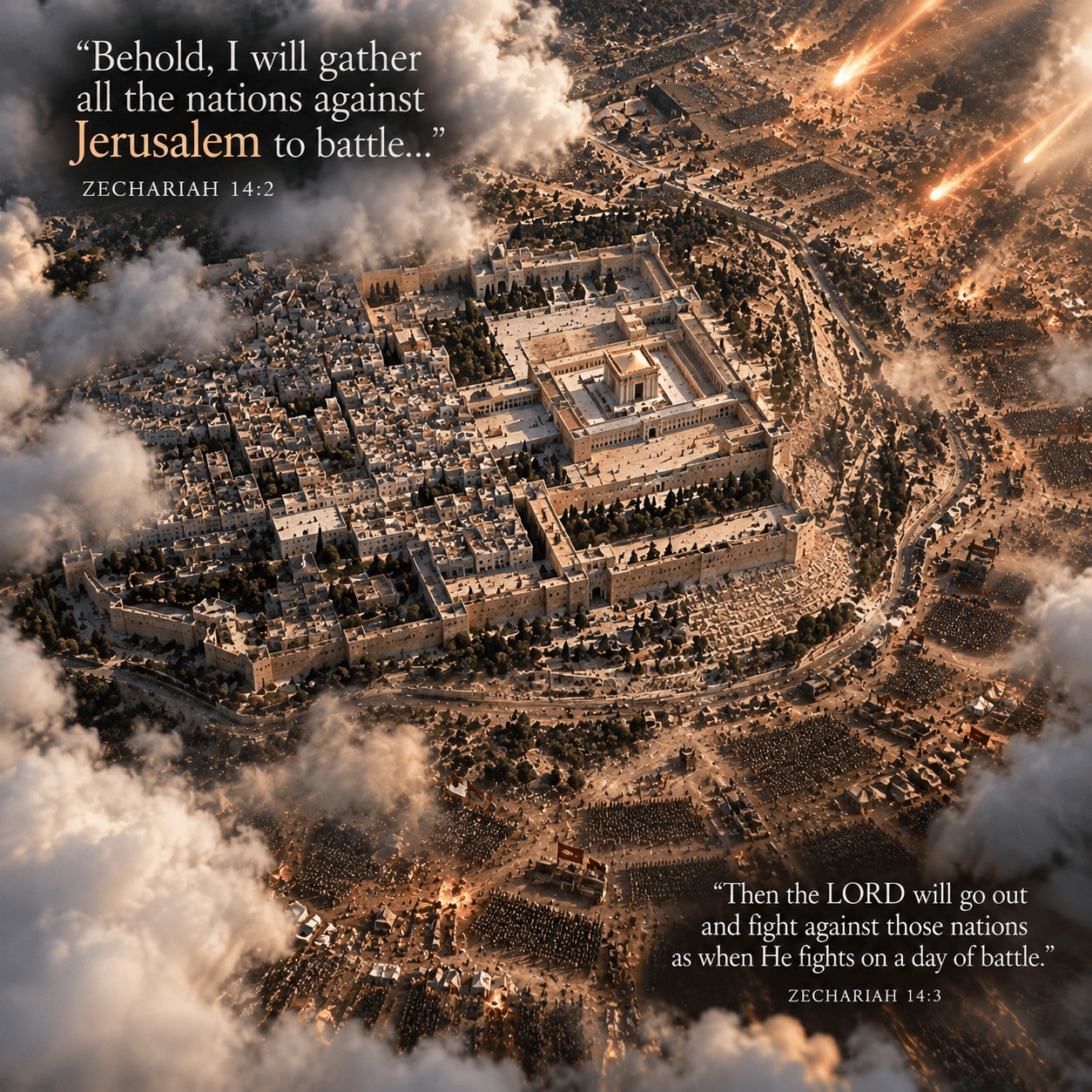
Aerial view of Jerusalem depicted as a city under siege, with texts from Zechariah 14:2 and 14:3 overlaying the image.

Armageddon

Few words evoke more images of worldwide catastrophe. Yet one of the most recognizable events in biblical prophecy is mentioned by name only ONCE in Scripture.

And its significance reaches deep into the Hebrew prophets.

1. ARMAGEDDON: WHERE DO THE ARMIES ACTUALLY GATHER?

“And they assembled them at the place that in Hebrew is called Armageddon.” (Revelation 16:16)

The Hebrew name Har-Magedon is traditionally associated with Megiddo in northern Israel, although its precise derivation remains debated.

Megiddo overlooks the Jezreel Valley, an ancient military crossroads where kings fought and kingdoms fell (Judges 5:19; 2 Kings 23:29).

But notice something frequently overlooked. Revelation identifies Armageddon as the gathering place, not necessarily the location of the decisive battle.

Meanwhile, Zechariah 12–14 repeatedly identifies Jerusalem as the focus of the nations’ hostility and God’s intervention.

Could Megiddo be the staging ground for a much larger military campaign culminating at Jerusalem? And why does John specifically emphasize the location’s Hebrew name?

Perhaps understanding Armageddon requires us to return to the Hebrew prophets.

2. WHO REALLY GATHERS THE NATIONS?

Revelation 16:14 describes demonic spirits gathering the kings of the world for battle.

Yet Joel 3:2 declares: “I will gather all the nations and bring them down to the Valley of Jehoshaphat. And I will enter into judgment with them there, on behalf of my people and my heritage Israel.”

And Zechariah 14:2 records the LORD saying: “For I will gather all the nations against Jerusalem to battle.”

Who is gathering them?

Satan gathers the nations in rebellion. God sovereignly gathers them for judgment.

The nations believe they are assembling for conquest. But they are approaching an appointment with the King.

This confrontation belongs to the broader Day of the LORD, anticipated throughout Joel, Zephaniah, Zechariah, and other Hebrew prophets.

Armageddon is not an isolated prediction buried in Revelation. It is connected to a prophetic narrative spanning centuries.

3. WHY DOES EVERYTHING CENTER ON ISRAEL AND JERUSALEM?

“On that day I will make Jerusalem a heavy stone for all the peoples.” (Zechariah 12:3)

“And on that day I will seek to destroy all the nations that come against Jerusalem.” (Zechariah 12:9)

Notice the geographical specificity. Israel. Judah. Jerusalem. The nations.

The prophets repeatedly identify the land and people at the center of this confrontation.

This raises a serious question for interpretations that understand these passages primarily symbolically: If God repeatedly identifies Jerusalem and Judah, what textual justification allows us to remove their geographical significance?

The Abrahamic Covenant includes an enduring land promise (Genesis 17:7–8).

The Davidic Covenant promises an enduring royal dynasty (2 Samuel 7:12–16).

God’s covenant purposes for Israel have not been canceled.

4. ISRAEL’S DELIVERANCE INVOLVES MORE THAN MILITARY VICTORY

Here is a remarkable detail often overlooked.

Zechariah 12:10 declares: “And I will pour out on the house of David and the inhabitants of Jerusalem a spirit of grace and pleas for mercy.”

The verse continues with the extraordinary prophecy concerning the One who was pierced and the mourning that follows.

The prophecy moves beyond national conflict to spiritual recognition and repentance.

Romans 11:26 adds: “And in this way all Israel will be saved.”

From a futurist understanding, Israel’s ultimate restoration involves both national deliverance and spiritual renewal through Yeshua HaMashiach.

The greatest miracle surrounding Jerusalem’s deliverance may not be the defeat of her enemies, but Israel’s recognition of her Messiah. The King who delivers Israel is also the One who redeems her.

5. THE MOUNTAIN THAT WITNESSED HIS DEPARTURE

“Then the LORD will go out and fight against those nations as when he fights on a day of battle.” (Zechariah 14:3)

“On that day his feet shall stand on the Mount of Olives that lies before Jerusalem on the east.” (Zechariah 14:4)

Acts 1:9–12 records Yeshua ascending from the Mount of Olives and the angels promising His return.

Acts doesn’t explicitly identify the location of His return, but the connection with Zechariah is remarkable.

The mountain that witnessed His departure may also witness His victorious return.

Revelation 19:19 describes the beast and the kings of the earth gathering to make war against the rider on the white horse.

The nations gather against the King of kings. But the outcome is never in doubt.

6. ARMAGEDDON IS NOT THE END OF HUMAN HISTORY

Revelation 19:19–21 describes Messiah’s victory over the beast and his armies.

But what happens next?

Revelation 20:1–3 describes Satan being bound for a thousand years.

“They came to life and reigned with Christ for a thousand years.” (Revelation 20:4)

Only AFTER the thousand years does Satan gather the nations for another rebellion (Revelation 20:7–10).

In the premillennial understanding, these are two distinct confrontations separated by a thousand years.

Amillennial interpreters commonly understand Revelation 20 as revisiting earlier events rather than continuing the chronology.

But the sequential reading raises an important question: If Armageddon immediately ends human history, why does Revelation describe a thousand-year reign followed by another rebellion?

Armageddon precedes the Messianic Kingdom.

The final rebellion follows it.

7. WHAT HAPPENS TO THE SURVIVING NATIONS?

Perhaps the most astonishing detail appears in Zechariah 14.

Verse 2 describes the nations gathering against Jerusalem for war.

Yet verse 16 declares: “Then everyone who survives of all the nations that have come against Jerusalem shall go up year after year to worship the King, the LORD of hosts, and to keep the Feast of Booths.”

Read that carefully.

SURVIVORS from the nations that attacked Jerusalem! The nations once approached Jerusalem in hostility. Now their survivors journey there to worship the King and celebrate Sukkot.

Zechariah 14:17–19 even describes consequences for nations refusing to participate.

The same chapter that begins with Jerusalem surrounded by enemies ends with the nations acknowledging the LORD’s kingship.

What an extraordinary reversal!

From WAR to WORSHIP.

From REBELLION to SUBMISSION.

From armies surrounding Jerusalem to nations worshiping the King.

And Zechariah 14:9 declares: “And the LORD will be king over all the earth.”

From a premillennial perspective, this describes life under Messiah’s earthly reign, before the final judgment and the eternal state.

8. THE KINGDOM GOD PROMISED HAS NOT BEEN CANCELED

The Hebrew prophets anticipated more than the defeat of Israel’s enemies.

They promised a restored Israel, a righteous Davidic King, and nations learning the ways of the LORD.

Isaiah 2:3 declares: “For out of Zion shall go forth the law, and the word of the LORD from Jerusalem.”

Micah 4:3 describes nations beating their swords into plowshares and learning war no more.

Armageddon does not erase God’s covenant promises. It brings the prophetic narrative toward their fulfillment.

CONSIDER THIS FINAL QUESTION:

If Armageddon marks the immediate end of human history, why does Zechariah describe survivors from the hostile nations traveling to Jerusalem year after year to worship the King?

The nations gather against Jerusalem.

The Messiah returns in victory.

Israel recognizes her Deliverer.

And the nations that once opposed His purposes must acknowledge His reign.

ARMAGEDDON IS NOT THE END OF GOD’S PLAN FOR THE EARTH. IT IS THE CLIMACTIC CONFRONTATION BEFORE THE PROMISED MESSIANIC KINGDOM.

“And the LORD will be king over all the earth.” (Zechariah 14:9)

Revelation 16:13–16; 19:11–21; 20:1–10 | Joel 3 | Zechariah 12–14 | Isaiah 2:2–4 | Micah 4:1–4 | Romans 11:25–27

Mark provides outstanding Biblical content on X @ https://x.com/Mark_Wilson_25/

ZECHARIAH: GOD REMEMBERS -Mark Wilson

Posted in #PaulthePoke, Mark Wilson with tags , , , , , , , , , , , , , , , , , on October 11, 2026 by paulthepoke

Mark provides outstanding Biblical content on X @ https://x.com/Mark_Wilson_25/
A figure dressed in biblical attire stands on a rocky ledge, overlooking a city with ancient architecture under a dramatic sky filled with rays of sunlight and clouds.

Zechariah is one of the most breathtaking books in all of Scripture.

Its name means “YHWH remembers,” and that truth runs through the entire book.

God remembers His covenant.
The LORD remembers Jerusalem.
The Holy One of Israel remembers His people.
The King remembers every promise He has spoken.

Zechariah begins with a returned remnant, a damaged city, and a Temple being rebuilt. But the prophecy quickly moves far beyond Zechariah’s own generation.

The horizon expands to Israel’s future, Messiah’s coming, Jerusalem’s central role, Israel’s repentance, the judgment of the nations, and the establishment of the Kingdom.

Zechariah is a prophetic mountain range.

GOD HAS NOT FORGOTTEN JERUSALEM

The LORD declares: “I am exceedingly jealous for Jerusalem and for Zion.” Zechariah 1:14

And again: “I have returned to Zion and will dwell in the midst of Jerusalem.” Zechariah 8:3

Then comes one of the most beautiful pictures of restoration: “Old men and old women shall again sit in the streets of Jerusalem… and the streets of the city shall be full of boys and girls playing.” Zechariah 8:4–5

Jeremiah gives the same assurance: “If this fixed order departs from before Me… then shall the offspring of Israel cease from being a nation before Me forever.” Jeremiah 31:35–36

And in that same chapter: “I will make a new covenant with the house of Israel and the house of Judah.” Jeremiah 31:31

Ezekiel adds: “I will take you from the nations and gather you from all the countries and bring you into your own land.” Ezekiel 36:24

Then comes spiritual renewal: “I will sprinkle clean water on you… and I will give you a new heart.” Ezekiel 36:25–26

Zechariah is not standing alone. He is part of a much larger prophetic chorus.

THE KING CAME HUMBLE

Zechariah foretold the arrival of Israel’s King: “Behold, your king is coming to you, righteous and having salvation is He, humble and mounted on a donkey.” Zechariah 9:9

Yeshua fulfilled that prophecy literally. But the next verse looks beyond His humble arrival: “His rule shall be from sea to sea, and from the River to the ends of the earth.” Zechariah 9:10

The same Messiah who came in humility will rule in glory. First the suffering. Then the crown.

THE SHEPHERD WOULD BE STRUCK

Zechariah also foretold Messiah’s rejection: “Strike the shepherd, and the sheep will be scattered.” Zechariah 13:7

Yeshua Himself applied this passage to what was about to happen to Him. But Zechariah never leaves the story at rejection. The Shepherd who was struck will return as King.

ISRAEL WILL LOOK UPON THE ONE THEY PIERCED

Zechariah 12 is one of the most remarkable passages in the Tanakh. The LORD says: “I will pour out on the house of David and the inhabitants of Jerusalem a spirit of grace and pleas for mercy.” Zechariah 12:10

Then comes the stunning line: “They will look on Me, on Him whom they have pierced, and they shall mourn for Him.”

Recognition. Repentance. Grace. Restoration.

And the next chapter follows with cleansing: “On that day there shall be a fountain opened for the house of David and the inhabitants of Jerusalem, to cleanse them from sin and uncleanness.” Zechariah 13:1

Yeshua later spoke of a future day when Jerusalem would welcome Him: “You will not see Me again, until you say, ‘Blessed is He who comes in the name of the Lord.’” Matthew 23:39

Paul says the same storyline continues in Romans 11: “A partial hardening has come upon Israel, until the fullness of the Gentiles has come in.” Romans 11:25

Then: “And in this way all Israel will be saved.” Romans 11:26

And why can we trust that promise? “For the gifts and the calling of God are irrevocable.” Romans 11:29

Israel’s story is not finished.

JERUSALEM WILL STAND AT THE CENTER OF WORLD EVENTS

Zechariah says: “I will make Jerusalem a heavy stone for all the peoples.” Zechariah 12:3

The nations gather against the city.

But Jerusalem is not only the center of conflict. It is also the center of the coming Kingdom.

Isaiah saw the same future: “It shall come to pass in the latter days that the mountain of the house of the LORD shall be established.” Isaiah 2:2

And: “For out of Zion shall go forth the law, and the word of the LORD from Jerusalem.” Isaiah 2:3

Jerusalem is not erased from the prophetic story. It becomes central to it.

THE GOD OF ISRAEL WILL INTERVENE

Zechariah describes a future moment when the nations gather against Jerusalem. Then: “The LORD will go out and fight against those nations as when He fights on a day of battle.” Zechariah 14:3

And then comes one of the most dramatic prophecies in Scripture: “On that day His feet shall stand on the Mount of Olives that lies before Jerusalem on the east.” Zechariah 14:4

The mountain splits. The geography is specific. Jerusalem. The Mount of Olives. A real city. A real mountain. A real intervention.

Revelation 19 describes Messiah’s triumphant return as heaven opens and the King comes in righteousness and judgment.

Then Revelation 20 follows with His thousand-year reign.

The sequence is powerful: The King returns. His enemies are judged. Israel is restored. The nations come under His rule. The Kingdom is established.

THE KING WILL REIGN OVER ALL THE EARTH

Zechariah reaches its climax here: “The LORD will be King over all the earth.” Zechariah 14:9

That is where history is heading. Not toward the failure of God’s promises. Not toward the abandonment of Israel. Not toward the disappearance of Jerusalem from the prophetic plan.

But toward the reign of the King.

Living waters will flow from Jerusalem. The nations will come to worship. The city will be holy.

And: “Everyone who survives of all the nations… shall go up year after year to worship the King.” Zechariah 14:16

That is the breathtaking message of Zechariah.

The God of Israel remembers. The Shepherd was struck. The King is coming. Jerusalem will see Him. Israel will be restored. The nations will worship.

And one day: “The LORD will be King over all the earth.” Zechariah 14:9

Every promise will stand.

~

Mark provides outstanding Biblical content on X @ https://x.com/Mark_Wilson_25/

WILL THERE BE A THIRD AND FOURTH JEWISH TEMPLE? – Mark Wilson

Posted in #PaulthePoke, Mark Wilson, Prophecy, Temple with tags , , , , , , , , , , on October 3, 2026 by paulthepoke

Mark provides outstanding Biblical content on X @ https://x.com/Mark_Wilson_25/

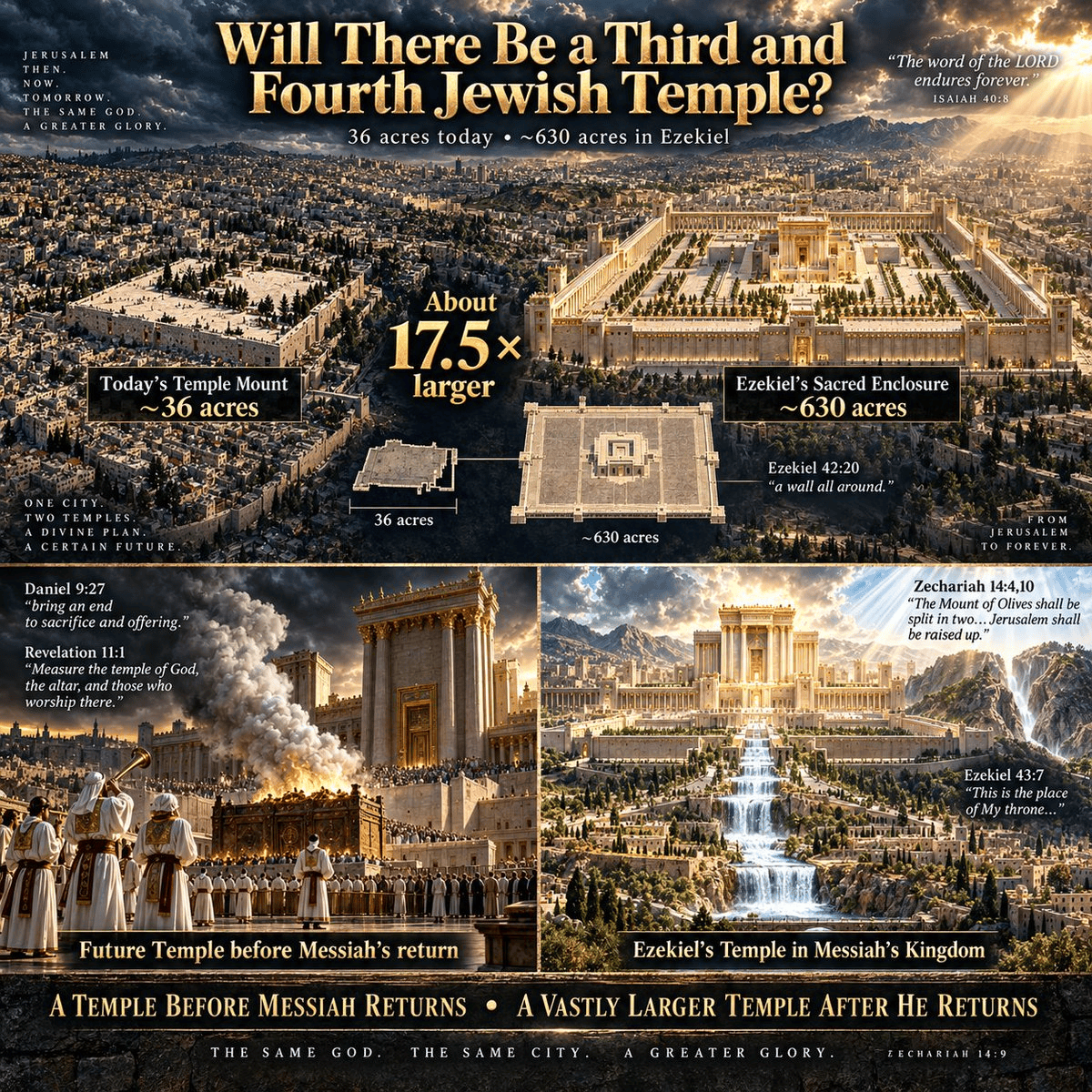
Infographic discussing the potential for a third and fourth Jewish temple, comparing the size of today's Temple Mount (36 acres) to Ezekiel's envisioned sacred enclosure (630 acres).

Here is a remarkable problem: Ezekiel’s future Temple complex does not fit on today’s Temple Mount.

The present Temple Mount covers approximately: 36 acres.

But on the traditional 500-reed reading of Ezekiel 42:15–20, Ezekiel’s sacred enclosure would cover roughly: 630 acres.

That is about 17½ times larger. 36 acres today.

630 acres in Ezekiel.

That is not a minor architectural difference. It may be an important clue that Scripture describes two different future Temple settings.

A TEMPLE BEFORE MESSIAH RETURNS

Daniel writes: “In the middle of the week he shall bring an end to sacrifice and offering.” Daniel 9:27

For sacrifice to be stopped, sacrifice must first be occurring.

Jesus then points directly back to Daniel: “When you see the ‘abomination of desolation,’ spoken of by Daniel the prophet, standing in the holy place…” Matthew 24:15

Paul adds that the man of lawlessness: “sits as God in the temple of God.” 2 Thessalonians 2:4

And John is told: “Rise and measure the temple of God, the altar, and those who worship there.” Revelation 11:1

The surrounding context gives us Jerusalem and 42 months.
Notice the progression:

Daniel: sacrifice.
Jesus: holy place.
Paul: Temple.
Revelation: Temple, altar, worshipers, Jerusalem, 42 months.

This is what Christians commonly call the Third Temple. The Bible never uses that number. It is simply shorthand for a Jewish sanctuary existing after the Second Temple and before Messiah’s kingdom.

AND THIS IS NO LONGER PURELY THEORETICAL

No Third Temple is currently under construction.

But preparations associated with future Temple worship are real.

The Temple Institute in Jerusalem continues preparing sacred vessels, priestly garments, and other elements connected with renewed Temple service. It has also clarified recent speculation about the red heifers: an earlier burning was only a practice exercise, while several heifers remain under evaluation. Jewish worship on the Temple Mount has also become more visible in 2026, including expanded use of prayer materials and public prayer in circumstances that would have been highly restricted in previous years.

None of this proves Daniel’s seventieth week has begun.

Prophecy calls for watchfulness, not date-setting.

But after nearly 2,000 years without a Jewish Temple, renewed discussion of Temple worship is no longer purely hypothetical.

THEN COMES JACOB’S TROUBLE

Jeremiah describes an unprecedented future crisis: “It is the time of Jacob’s trouble, but he shall be saved out of it.” Jeremiah 30:7

Daniel echoes it: “There shall be a time of trouble, such as never was since there was a nation.” Daniel 12:1

Jesus uses almost identical language: “Then there will be great tribulation, such as has not been since the beginning of the world.” Matthew 24:21

Jeremiah.

Daniel.

Jesus.

An unparalleled crisis centered on Israel and Jerusalem, followed by deliverance.

ZECHARIAH SHOWS WHY THIS IS STILL FUTURE

Zechariah says: “Two-thirds in it shall be cut off and die, but one-third shall be left in it.” Zechariah 13:8

Then the surviving third is refined: “They will call on My name, and I will answer them. I will say, ‘This is My people’; and each one will say, ‘YHVY is my God.’” Zechariah 13:9

And the prophecy continues directly into chapter 14:

Jerusalem attacked. The nations gathered. YHVY goes forth to fight. His feet stand upon the Mount of Olives. Zechariah 14:1–4

That complete sequence has never occurred.

Neither Antiochus IV nor AD 70 fulfilled it.

The Holocaust was an unspeakable catastrophe, but it did not culminate in the full Zechariah 13–14 sequence of national refining, YHVY’s intervention, and His feet standing upon the Mount of Olives.

That is why the futurist reading understands Jacob’s Trouble as still future.

DOES THE TANAKH REALLY REQUIRE TWO FUTURE TEMPLES?

This is one of the strongest Jewish objections.
A Jewish reader can reasonably argue:

Daniel’s desecration prophecies were fulfilled in ancient history, while Ezekiel 40–48 describes the future Messianic Temple. Why introduce another Temple between them?

So leave the New Testament aside for a moment.
Daniel 12 itself gives us:

Sacrifice.
Abomination.
Unparalleled trouble.
Israel’s deliverance.
Resurrection.

Daniel 12:1–2, 11
Antiochus IV did not complete that sequence.
Neither did Titus in AD 70.

Zechariah likewise points to a future crisis culminating in YHVY’s direct intervention at Jerusalem.

The Tanakh itself therefore points toward a future climactic period involving Israel, Jerusalem, sacrifice, desecration, national refining, divine intervention, and deliverance.

The New Testament does not invent that expectation.

It adds further detail.

COULDN’T EZEKIEL’S TEMPLE SIMPLY BE THE NEXT TEMPLE?

Possibly, if the settings were the same. But they are not.

The sanctuary associated with Daniel exists amid: Sacrifice. Desecration. Unprecedented trouble. Jerusalem under assault.

Ezekiel’s Temple exists after restoration, in a reordered land, with tribal allotments, a supernatural river flowing from the sanctuary, and YHVY declaring:

“This is the place of My throne… where I will dwell in the midst of the children of Israel forever.” Ezekiel 43:7

Then comes the size problem again:

Present Temple Mount: ~36 acres. Ezekiel’s enclosure: ~630 acres.

How could it fit?

Perhaps it is not supposed to fit today’s Jerusalem.

Zechariah says that when Messiah comes: “The Mount of Olives shall be split in two.” Zechariah 14:4

And: “All the land shall be turned into a plain… Jerusalem shall be raised up.” Zechariah 14:10

Ezekiel’s Temple belongs to a transformed Jerusalem after Messiah returns.

DOESN’T THE CROSS END TEMPLE SACRIFICES FOREVER?

This is probably the strongest Christian objection.

Hebrews is unmistakable: “We have been sanctified through the offering of the body of Jesus Christ once for all.” Hebrews 10:10

Christ’s sacrifice cannot be repeated or supplemented.

Yet Ezekiel 40–48 unmistakably describes sacrifices.

Therefore those sacrifices cannot provide eternal redemption.

Whatever ceremonial function they serve in Messiah’s kingdom, they cannot compete with Calvary.

Hebrews must mean exactly what Hebrews says.
And Ezekiel must mean exactly what Ezekiel says.

THE PROPHETIC SEQUENCE

Second Temple destroyed

↓

Future Jewish Temple

↓

Sacrifice restored

↓

Abomination of desolation

↓

Jacob’s Trouble

↓

Two-thirds cut off, one-third refined

↓

Israel calls upon YHVY

↓

The nations gather against Jerusalem

↓

Messiah returns

↓

Mount of Olives splits

↓

Jerusalem is transformed

↓

Ezekiel’s approximately 630-acre sacred enclosure

↓

Messiah’s kingdom

And eventually comes the New Jerusalem: “I saw no temple in it, for the Lord God Almighty and the Lamb are its temple.” Revelation 21:22

So will there be a Third and Fourth Jewish Temple?

If these prophetic texts retain their ordinary historical, geographical, and national meaning, the sequence is remarkably coherent:

A Temple before Messiah returns.

A vastly different Temple after He returns.

“And YHVY shall be King over all the earth. In that day it shall be, YHVY is one,’ and His name one.” Zechariah 14:9

Mark provides outstanding Biblical content on X @ https://x.com/Mark_Wilson_25/

Zechariah Begins With Ruins & Ends With A King -Mark Wilson

Posted in #PaulthePoke, Mark Wilson, Prophecy with tags , , , , , , on August 20, 2026 by paulthepoke

Mark provides outstanding Biblical content on X @ https://x.com/Mark_Wilson_25/

If you want to know where the story of Jerusalem is going, read Zechariah.

The book begins with a battered people returning from exile.

Jerusalem is wounded.

The Temple is being rebuilt.

The nation looks small.

But the prophet begins to see things far greater than anything happening in his own generation.

YHVH declares:

“Sing and rejoice, O daughter of Zion: for, lo, I come, and I will dwell in the midst of thee.” Zechariah 2:10

And then:

“YHVH shall inherit Judah his portion in the holy land, and shall choose Jerusalem again.” Zechariah 2:12

That is where Zechariah is going.

He sees the Branch.

He sees the King.

He sees the Shepherd.

He sees the Pierced One.

And finally, he sees YHVH reigning over all the earth.

Zechariah starts among ruins.

It ends with glory.

~

First comes the Branch.

“Behold, I will bring forth My servant the Branch.” Zechariah 3:8

Then Zechariah reveals something extraordinary: “He shall bear the glory, and shall sit and rule upon His throne; and He shall be a priest upon His throne.” Zechariah 6:13

A ruler.

A priest.

One throne.

One mysterious figure bearing glory.

Who is He?

Zechariah is not finished.

~

Then the King appears.

“Behold, thy King cometh unto thee… lowly, and riding upon an ass.” Zechariah 9:9

The King comes humbly.

But the very next verse looks beyond His humility: “His dominion shall be from sea even to sea, and from the river even to the ends of the earth.” Zechariah 9:10

The One who arrives gently will ultimately rule universally.

But Zechariah is not finished.

~

The Shepherd is rejected.

And the price placed upon Him? Thirty pieces of silver. “So they weighed for my price thirty pieces of silver.” Zechariah 11:12

Then comes an astonishing statement from YHVH: “Cast it unto the potter: a goodly price that I was prized at of them.” Zechariah 11:13

Read that carefully.

The Shepherd is rejected.

Yet YHVH speaks of the price as the value placed upon Himself.

Why?

Zechariah is not finished.

~

Now Jerusalem becomes the center of an international crisis.

“I will make Jerusalem a burdensome stone for all people.” Zechariah 12:3

The nations gather.

YHVH intervenes.

“I will seek to destroy all the nations that come against Jerusalem.” Zechariah 12:9

Then suddenly: “They shall look upon Me whom they have pierced, and they shall mourn for Him, as one mourneth for his only son.” Zechariah 12:10

Stop there.

Who is speaking? YHVH.

Who was pierced? The text says: Me.

Yet the people mourn for: Him.

And not casually. They mourn as for an only son.

Who is this Pierced One whose rejection is somehow described as the piercing of YHVH?

What happens when Israel finally recognizes Him? Cleansing.

“In that day there shall be a fountain opened to the house of David and to the inhabitants of Jerusalem for sin and for uncleanness.” Zechariah 13:1

Mourning becomes cleansing.

Rejection becomes restoration.

But Zechariah is still not finished.

~

Then comes chapter 14.

Jerusalem is surrounded. The nations have gathered. Humanly speaking, the situation is impossible.

Then: “YHVH shall go forth, and fight against those nations.” Zechariah 14:3

And suddenly the prophecy becomes breathtakingly physical: “His feet shall stand in that day upon the Mount of Olives, which is before Jerusalem on the east.” Zechariah 14:4

His feet.

The Mount of Olives.

Jerusalem.

The mountain splits.

Living waters flow from Jerusalem.

And then comes the climax: “YHVH shall be King over all the earth.” Zechariah 14:9

But even that is not the end.

Zechariah had already declared: “I am returned unto Zion, and will dwell in the midst of Jerusalem.” Zechariah 8:3

And ultimately: “Many people and strong nations shall come to seek YHVH of hosts in Jerusalem.” Zechariah 8:22

The nations do not replace Jerusalem.

They come to Jerusalem.

~

Now look at the progression.

In chapter 9: The King rides on a donkey.

In chapter 11: The Shepherd is valued at thirty pieces of silver.

In chapter 12: The Pierced One is recognized.

In chapter 13: Israel is cleansed.

In chapter 14: His feet stand on the Mount of Olives.

And then: YHVH reigns over all the earth.

First humility. Then glory.

First rejection. Then recognition.

First piercing. Then cleansing.

First Jerusalem surrounded. Then Jerusalem exalted.

First the Shepherd is rejected. Then the King is worshiped.

~

So Zechariah leaves us with questions that refuse to disappear. Who is the Branch?

Who is the King?

Who is the rejected Shepherd?

Who is the One YHVH calls “Me” who was pierced?

Whose feet stand upon the Mount of Olives?

And who ultimately reigns as King over all the earth?

Zechariah does not merely predict events.

Zechariah unveils the coming King.

~

Mark provides outstanding Biblical content on X @ https://x.com/Mark_Wilson_25/

Gabriel: Good News is Coming

Posted in #PaulthePoke, Angels with tags , , , , , , , on May 12, 2020 by paulthepoke

Luke 1:19 “I am Gabriel,” replied the angel. “I stand in the presence of God, and I have been sent to speak to you and to bring you this good news.

Clearly, Zechariah is not sure what to make of all of this. Gabriel attempts to make it crystal clear. My word is good.

First is his name. Gabriel means “man of God” or “strong man of God”. The message to Zechariah is simple. He is listening to a “strong man of God”.

Second, Gabriel tells the priest his domain is the literal presence of God. The Greek word used is παρίστημι/paristémi. It means: to place beside, to present, stand by, appear. The idea is Gabriel is close to God. He is in the inner circle if you will.

…and I have been sent to speak to you… Third, God Himself sent Gabriel to personally talk to Zechariah.

…and to bring you this good news. This is the Greek word that is synonymous with “the gospel” message, εὐαγγελίζω/euaggelizó. Gabriel is personally bringing “good news” from God to you.

Luke 1:20 And now you will be silent and unable to speak until the day this comes to pass, because you did not believe my words, which will be fulfilled at their proper time.”

Zechariah is no different than any of us. He did not believe God’s message. And Zechariah was a priest serving God in the Temple at the time of these events. None of us are completely obedient. We all have times when we question or neglect what God has to say.

Because of his lack of faith, Zechariah would be silenced and diagnosed with Expressive Aphasia.  This is a type of aphasia characterized by partial loss of the ability to produce language (spoken, manual, or written), although comprehension generally remains intact. In Zechariah’s case, his loss was not partial. https://www.aphasia.org/aphasia-definitions/

Luke 1:18 And Zechariah said to the angel, “How shall I know this? For I am an old man, and my wife is advanced in years.”

It would appear Elizabeth was not pregnant at this time based on Zechariah’s comments in Luke 1:18. There would be no whispering of sweet nothings in Elizabeth’s ear. John the Baptist was conceived by an old man with expressive aphasia and a sterile, old, geriatric woman. What seems impossible to humanity is God’s reality.

Notice, the length of time of Zechariah’s aphasia is open ended. Gabriel does not give a definitive time. He was mute for at least 9 months. Zechariah will not talk until Gabriel’s personal prophecy is fulfilled.

Zechariah ultimately regained his ability to speak. This is observed later in Luke 1. And when he recovers, he has a lot to say.

Luke 1:64 And immediately his mouth was opened and his tongue loosed, and he spoke, blessing God.

See Zechariah’s song and prophecy in Luke 1:67-79.

Salvation is coming…

Forerunners to Christ, John the Baptist and Elijah

Posted in #PaulthePoke, Angels with tags , , , , , , , , on May 3, 2020 by paulthepoke

Luke 1:17 and he will go before Him in the spirit and power of Elijah, to turn the hearts of the fathers to the children, and the disobedient to the wisdom of the just, to make ready for the Lord a people prepared.

The angel Gabriel continues his prophecy of Zechariah’s son, John the Baptist.

Look carefully, he (John the Baptist) will come before the Messiah. John the Baptist is not Elijah. John comes in the spirit and power of Elijah.

Later, Jesus Himself would confirm that John the Baptist functions as if Elijah.

Matthew 11:14 “And if you are willing to accept it, John himself is Elijah who was to come.” –Jesus.

John’s purpose is to make ready for the Lord a people prepared.

As Gabriel stated previously, the ministry of John the Baptist will associated with joy, gladness, and the grace of God. People will turn back to the Lord. This is the Hebraic concept of Teshuvah.

John the Baptist is associated with the first coming of Christ. Elijah is associated with the second coming.

In both the first and second comings of Jesus, the two forerunners to Christ will change the hearts of children and fathers.

Compare Gabriel’s comments to Malachi 4:5-6. These are the last words of the Old Testament. From Gabriel back to Malachi, it had been approximately 425 years since God had communicated with the Jewish people.

Malachi 4:5-6 Behold, I will send you Elijah the prophet before the great and awesome day of the LORD comes. He will restore the hearts of the fathers to their children and the hearts of the children to their fathers, so that I will not come and smite the land with a curse.

Elijah’s purpose… so that I will not come and smite the land with a curse.

When Elijah comes a second time, he will precede the second coming of Christ. His ministry will be associated with the great and awesome day of the LORD.

Although he is not specifically named, Elijah is likely one of the two witnesses in Revelation 11. The skill set and characteristics of the witnesses are consistent with the prophet Elijah on his first mission.

See 1 Kings 17-21 and 2 Kings 1-2 for Elijah’s initial career and efforts.

Revelation 11:3 And I will grant authority to my two witnesses, and they will prophesy for twelve hundred and sixty days, clothed in sackcloth.

Elijah will be dressed in sackcloth. These garments are made of a coarse, dark cloth from a goat. In Elijah’s day, sackcloth was worn in times of mourning, distress, mortification, or penitence.

Elijah promises fire, drought, water to blood, and all kinds of plagues.

Elijah will be an instrument of judgment.

Return to the Lord

Posted in #PaulthePoke, Angels, Teshuvah/Repent with tags , , , , , on April 26, 2020 by paulthepoke

Luke 1:16 And he will turn many of the children of Israel to the Lord their God…

And he will turn… ἐπιστρέφω/epistrephó in the Greek. As defined by Strong’s Concordance, the term means to return. Thayer’s Lexicon interprets the idea as to cause to return, to bring back, to turn oneself about, or come back. The idea is in a literal, physical sense. Stop going in the path one is taking. Turn and go in a different direction.

This term is used 36 times in the New Testament. Below are a few examples how ἐπιστρέφω/epistrephó is utilized.

Luke 2:39 When they had performed everything according to the Law of the Lord, they returned to Galilee, to their own city of Nazareth.

Matthew 12:44 Then it says, ‘I will return to my house from which I came.’ And when it comes, it finds the house empty, swept, and put in order.

2 Peter 2:22 What the true proverb says has happened to them: “The dog returns to its own vomit, and the sow, after washing herself, returns to wallow in the mire.”

People were going the wrong way and had left the God of Israel. The angel Gabriel is telling Zechariah the priest his son to be, John the Baptist, will be the reason fellow country men will return to God.

Return to the Lord. To the Jew, this is the concept of Teshuvah. In our western world, the term we are familiar with is “repent”.

Teshuvah is a time to turn toward God. People are called to turn away from their sin, repent, and change course. Let go of the ways of the world. It is a time of inward reflection and sincere self-assessment. The goal is a change in lifestyle away from sin to obedience in God’s word. Return to God and His ways. This is not a warm and fuzzy spiritual word that causes your stomach to flutter or hair to stand on your neck. There should be some conviction. Be honest. Right is right and wrong is wrong. We can all do better. Prepare and turn to God with a joyful heart.

Teshuvah is a 40 day period in the late summer of the year. This is the season to prepare for the Jewish New Year, Rosh Hashanah and the Day of Atonement or Yom Kippur.

Elul is the last month of the civic calendar in Judaism. Elul is the sixth month of the religious calendar. Elul 1 marks the beginning of Teshuvah. The 40 day period of Teshuvah ends on Tishri 10 in the Hebrew calendar, Yom Kippur.

Gabriel: Prophecy of John the Baptist

Posted in #PaulthePoke, Angels with tags , , , , , on April 19, 2020 by paulthepoke

Luke 1:14 And you will have joy and gladness, and many will rejoice at his birth…

Gabriel is revealing the promise of Zechariah’s son to him, John the Baptist. Zechariah is told his son will result in joy and gladness. In the Greek language, the root word for joy is a form of the word for grace or χαρά/chara. In other words, Zechariah will experience joy because of God’s grace. As a father, Zechariah would also experience “gladness” or ἀγαλλίασις/agalliasis. The translation of “gladness” does not fully define the term. Other translations could include wild joy, ecstatic delight, exultation, or exhilaration as noted by Strong’s Concordance.

and many will rejoice at his birth… The birth of John the Baptist will result in others to “rejoice”. This is the verb form of grace or χαίρω/chairó.

John the Baptist will be a source of God’s grace.

Luke 1:15 for he will be great before the Lord. And he must not drink wine or strong drink, and he will be filled with the Holy Spirit, even from his mother’s womb.

…for he will be great before the Lord.

God’s view of John the Baptist is “great” or μέγας/megas. John will be large, great, in the widest sense. -Strong’s Concordance.

And he must not drink wine or strong drink…

Many take this charge to be a Nazarite vow. This concept has its origins in Numbers 6:1-21. John the Baptist is to set himself apart and dedicate himself to God for his entire life. John is one of three people in the Bible who were to devote their lives with a Nazarite vow to God. The other two were Samson and Samuel.

In general, there are three primary considerations when taking a Nazarite vow. One, a person is not to drink wine or any beverage product that comes from a grape. A person is not to eat grapes or raisins either. Two, no razor shall touch his head. In other words, no hair cuts or facial shaving allowed. Three, one is not to come in contact with a dead body.

~

and he will be filled with the Holy Spirit…

Keep in mind, this is before the giving of the Spirit at Pentecost. That event was yet future.

There were not many people who were blessed with the indwelling of the Holy Spirit prior to John the Baptist. Aspects of the Spirit allowed Moses, Joshua, Saul, and Solomon to carry out various duties with God given insights.

King David particularly valued the Holy Spirit.

Psalm 51:10-12 Create in me a clean heart, O God, and renew a right spirit within me. Cast me not away from your presence, and take not your Holy Spirit from me. Restore to me the joy of your salvation, and uphold me with a willing spirit.

~

…even from his mother’s womb.

This promise is confirmed later in the book of Luke.

Luke 1:41 And when Elizabeth heard the greeting of Mary, the baby leaped in her womb. And Elizabeth was filled with the Holy Spirit.

Luke 1:80 And the child grew and became strong in spirit, and he was in the wilderness until the day of his public appearance to Israel.

Zechariah, Meet Gabriel

Posted in #PaulthePoke, Angels with tags , , , on March 22, 2020 by paulthepoke

Luke 1:11 And there appeared to him an angel of the Lord standing on the right side of the altar of incense.

So Zechariah the priest is minding his own business by himself in the Temple…

And there appeared… ὁράω/horaó in the Greek. Defined, the term means to see or intently stare. Imagine being by yourself and a being shows up out of thin air. One might lock in on what is being seen.

Luke 1:12 And Zechariah was troubled when he saw him, and fear fell upon him.

Let’s look at the description of Zechariah when he realized the angel later to be identified as Gabriel.

We have the benefit of knowing Zechariah is meeting Gabriel. Zechariah will find this out later in the conversation.

Luke 1:19 And the angel answered him, “I am Gabriel. I stand in the presence of God, and I was sent to speak to you and to bring you this good news.

Zechariah was troubled or ταράσσω/tarassó. It could also mean to be stirred up or agitated.

Zechariah was overwhelmed or seized with fear or φόβος/phobos. The word can be defined as panic flight, fear, the causing of fear, terror. In English, we get the word “phobia” from the Greek.

Zechariah and the virgin Mary have the same initial response to Gabriel. The same Greek terms are used. Both were stirred up and scared.

Gabriel, for his part, has the same response to both Zechariah and Mary. He tells both of them to not be afraid and he calls them by name.

Luke 1:13a But the angel said to him, “Do not be afraid, Zechariah…

Luke 1:30a And the angel said to her, “Do not be afraid, Mary…

Likely to Zechariah’s surprise, the being knows his name and his wife’s name Elizabeth. Then Gabriel shares some information with Zechariah. You are going to be a father and you are going to name the child John.

Luke 1:13b …and you shall call his name John.

Zechariah the Priest & Prayer

Posted in #PaulthePoke, Angels with tags , , , , , , , , on March 15, 2020 by paulthepoke

Luke 1:5a In the days of Herod, king of Judea, there was a priest named Zechariah, of the division of Abijah…

Luke 1:8 Now while he was serving as priest before God when his division was on duty…

This is the introduction of Zechariah the priest, father of John the Baptist.

But first, let’s look at the name Zechariah. His name means “Yah has remembered”. It would appear, Zechariah is the first person to talk to the angel (Gabriel) in the New Testament. We know that he has prayed for a child.

Luke 1:13a But the angel said to him, “Do not be afraid, Zechariah, for your prayer has been heard…

A man whose name means “Yah remembers” has prayed to Yahweh. Yah has heard, remembered, and grants “Yah remembers” his wish. Then “Yah remembers” does not believe Yah remembered him and discounts the promise of a child.

Luke 1:18 “How can I be sure of this?” Zechariah asked the angel. “I am an old man, and my wife is well along in years.”

~

Luke 1:11 Just then, an angel of the Lord appeared to Zechariah, standing at the right side of the altar of the incense.

The angel was located at the right side. Symbolically, the right of God is known as a position of presence, power, and authority. Christ has ascended into Heaven and is located at the right hand of the Father.

golden_altar_of_incense

The directions for the construction and purpose of the altar of incense are located in Exodus 30. The priests are instructed to burn incense continually. This is a request for all generations. The burning of incense is perpetual.

Exodus 30:7-8 And Aaron shall burn fragrant incense on it. Every morning when he dresses the lamps he shall burn it, and when Aaron sets up the lamps at twilight, he shall burn it, a regular incense offering before the LORD throughout your generations.

The incense is fragrant and pleasing to smell. God only wants incense from this altar.

Exodus 30:9 You shall not offer unauthorized incense on it, or a burnt offering, or a grain offering, and you shall not pour a drink offering on it.

In Revelation, in the throne room of Heaven, the incense is equated with prayers.

Revelation 8:3 And another angel came and stood at the altar with a golden censer, and he was given much incense to offer with the prayers of all the saints on the golden altar before the throne…

Despite being a priest and serving God in the Temple, Zechariah did not believe God’s message. He was still granted his prayer request. But with his unbelief, there was a consequence. Silence!

Luke 1:20 And now you will be silent and unable to speak until the day this comes to pass, because you did not believe my words, which will be fulfilled at their proper time. -Gabriel

Do not underestimate the power of our prayers. Gabriel was located at a position of authority near the symbol for prayers.

Prayer should be part of our lives. God wants us to communicate with Him. He desires to hear from us. Our prayers are a sweet aroma to Him. He does listen and He always remembers.

1 Thessalonians 5:17-19 pray without ceasing, give thanks in all circumstances; for this is the will of God in Christ Jesus for you. Do not quench the Spirit.